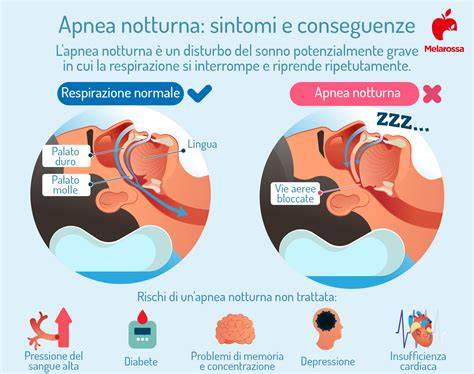
Sleep apnea is a potentially serious sleeping disorder that makes your breathing stop and start during sleep. The most common type of this disorder is obstructive sleep apnea (OSA). This occurs when your throat muscles randomly relax and block your airway during sleep, causing you to stop breathing repeatedly.
Sleep apnea is a sleep disorder that affects nearly 18 million Americans. Those who suffer from the condition experience pauses in their sleep that last as long as 10 seconds and may cause them to awaken abruptly, gasping for breath, before they fall back asleep. This pattern of not breathing is repeated while the person is sleeping, creating interrupted sleep instead of periods of good rest.
Ruolo del dentista nel riconoscimento e nel trattamento
For a lot of people, the first time they realize they have a sleeping disorder is from talking to their dentist. Surprisingly enough, your oral health could be to blame for your trouble sleeping. Your dentist can create a custom intraoral appliance, made of comfortable plastic, that repositions your jaw to leave your airway open while you sleep. Because grinding and clenching your teeth is a cause of sleep apnea, another treatment your dentist may recommend is wearing a nightguard. Whether you think you have sleep apnea or not, if you’re having trouble sleeping, talk to your dentist about what you think could be causing it.
Shwartzman and Ronkin treat patients with obstructive sleep apnea. “We started to treat sleep apnea about 20 years ago,” Shwartzman explained. “My husband was in his 40s and was snoring. Obstructive sleep apnea happens when a person’s throat muscles relax and block the airway while the person is sleeping; Ronkin added that the tongue and soft tissues can block the airway. Shwartzman and Ronkin used to treat their patients with different types of oral devices, but about a year ago Ronkin attended a conference in New York during which he was introduced to the Vivos appliance. The appliances that they had used prior to that were developed to hold the jaw down and back.
Patients who are new to the practice fill out the Berlin Sleep Apnea Questionnaire and the Epworth Sleepiness Scale. The two dentists have trained their dental staff to check patients for signs of potential sleep apnea that a patient may be experiencing. “As dentists, we cannot diagnose,” Shwartzman said. Following the diagnosis, the patient returns to Dream Smile Dental for treatment. The dentists then make the Vivos appliance for the patient, who will wear it for 12 to 16 hours a day. Ronkin said that the Vivos appliance opens the airway and also develops the mid face (upper jaw) to the point that after a certain period of time, many patients will no longer need to use it. Their sleep apnea will have been cured. Shwartzman and Ronkin treat their younger patients with Vivos as well. “We make the appliances for children,” Shwartzman said. “They might not need orthodontics.”
“Dentists are not just about saving teeth, but saving lives,” Shwartzman said. Ronkin added that some children who are diagnosed with Attention Deficit Disorder (ADD) may actually have sleep apnea. Jeannine Reid, scheduling coordinator for Shwartzman, said that meetings are held at Dream Smile Dental to inform people about sleep apnea and its treatment. “It’s a good way for people who are not patients to come in and meet the staff, learn what sleep apnea is, and how to treat it,” she explained.
Apnee ostruttiva del sonno: aspetti clinici e approcci terapeutici
Obstructive Sleep Apnea (OSA) is a common disorder in the Canton area involving collapse of the upper airway during sleep. This repetitive collapse results in frequent awakenings and tiredness during the day, even with adequate sleep time. As specialists in upper airway anatomy, physiology and surgery, We are uniquely qualified to treat patients with OSA. Surgical treatment of pediatric sleep disordered breathing with tonsillectomy and adenoidectomy is the recommended first line treatment. In the pediatric population, resolution of OSA occurs in 82% of patients who are treated with tonsillectomy and adenoidectomy.
In most patients with moderate to severe sleep apnea, continuous positive airway pressure (CPAP) is the first line treatment. Successful long term treatment of OSA with CPAP is difficult to achieve and fewer than 50% of patients on CPAP are adequately treated, as defined by 4 hours of use 70% of nights. Surgical procedures may be considered as a secondary treatment for Obstructive Sleep Apnea when the outcome of CPAP therapy is inadequate, such as when the patient is intolerant of CPAP, or CPAP therapy is unable to eliminate OSA. Surgery may also be considered as a secondary therapy when there is an inadequate treatment outcome with an oral appliance (OA), when the patient is intolerant of the OA, or the OA therapy provides unacceptable improvement of clinical outcomes of OSA (Consensus).
When CPAP is inadequate to control the symptoms of sleep apnea, and after examination, there is found to be a site of obstruction with the tonsils, adenoids, or nasal septum, surgery may be recommended. Surgery is designed to remove the tonsils and a small portion of the uvula and soft palate. This has the net effect of opening the inlet of breathing at night, reducing or eliminating the need for CPAP. Afterwards, weight loss and regular aerobic activity is encouraged to maintain results. After a thorough history and physical examination an overnight sleep study may be recommended to determine if sleep apnea is present. A new device, which allows home sleep study, is available. This is more convenient and less expensive for most patients. Obstructive sleep apnea occurs when the airway collapses during sleep and blocks the flow of oxygen to the brain. The brain senses a lack of oxygen and wakes the body up just long enough to take a breath, then falls back asleep.
Terapie avanzate e soluzioni personalizzate
Inspire therapy, an obstructive sleep apnea treatment option for those who cannot use Continuous Positive Airway Pressure (CPAP) therapy. Inspire provides mild stimulation to open the patient’s airway during sleep, allowing oxygen to flow naturally. Once the Inspire device is implanted, the patient comes to the Blessing Sleep Center to have it activated and adjusted to their individual need for airway stimulation.
Oral Appliance Therapy is often used for less serious cases of sleep apnea, as it is far more comfortable than CPAP. An oral appliance is designed to keep the airway open to allow for air to pass. We design a personalized oral appliance that will keep the jaw in a forward position while you sleep, allowing your airway to remain open for an uninterrupted, better night’s sleep. Dr. Goch treats sleep apnea using oral appliances. If you think you may suffer from sleep apnea, Dr. Due to impaired breathing during the night, the body can suffer from a lack of oxygen.